16 March 2014

Centenary of Military Aviation

Australian Defence Force Image Library

Avro 643 Cadet
de Havilland DH 94 Moth Minor
de Havilland DH 82 Tiger Moth


NA T-6 Texan
CAC CA-12 Boomerang
CAC CA-12 Boomerang
CAC CA-12 Boomerang
Lockheed Hudson
Lockheed Hudson
Lockheed Hudson
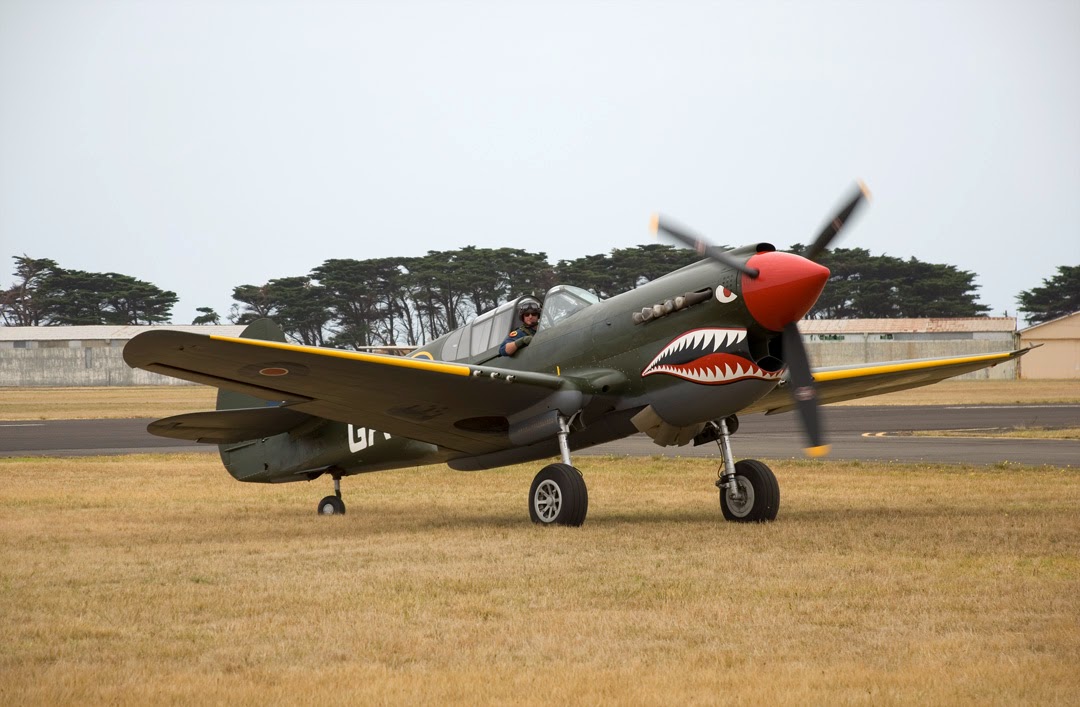
Curtiss P-40F Warhawk
Curtiss P-40N Kittyhawk
Consolidate PBY-6A Catalina
Supermarine Spitfire MKVIII
CAC CA-18 Mustang
Douglas C-47 Dakota
Gloster Meteor MK8
Gloster Meteor MK8
Gloster Meteor MK8
Gloster Meteor MK8

CAC CA-25 Winjeel
de Havilland DH 100 Vampire
Cessna C180
Cessna C180
DHC-4 Caribou

27 February 2014

Hobby Boss 1/72 Sikorsky UH-34D 'Choctaw'


I started this kit back in July 2013 whilst attending the IPMS model camp, with the sole purpose of building it as an out-of-box model and just for a bit of FUN. Although I managed to get most of the parts cleaned up and the majority of the model assembled, it was eventually shelved due to an overseas holiday, followed by the need to finish off an F-15E Strike Eagle for a customer.

With the latter project completed I then wanted something easy to do, which wasn't going to be to taxing and the Choctaw fitted the bill perfectly. However, during the time the model had been laid up I'd managed to collect and study a lot of photos on the subject and realised that the kit had quite a few short comings. 

Therefore, in an endeavor to make the model at least look like a Choctaw, and avoid the onset of AMS, I decided to add the mesh covers, grab handles, tie-down points, steps, seat-belts and instrument panel from an Eduard etch set. The cockpit glare shield, underside armor plate and aft rotating beacon from plastic card, and brake-lines, hydraulic lines, fuselage vent pipes and whip aerial from fuse wire. This being pretty much all I wanted to do.

I was also fortunate enough to be able to score a decal sheet and upper rear louvered fuselage panel from an Italeri kit, thanks to a friend who'd built his kit as a Wessex and had these left over items to spare. The Italeri part is far more accurate than the Hobby Boss offering and the decals are much more interesting in their choice of subject, hence why I choose the early Vietnam, Marine scheme.

I painted the model entirely in Vallejo Air colors and masked off several panels, which were then sprayed with a 50:50 mix of Field Green and Radome Tan, to give a little more variation. I then sprayed the centers and edges of selected panels with the same mix, although a little more lightly, to represent fading. The model was then gloss coated - with Future - the decals applied and the panel lines and mesh accentuated with several coats of Vallejo's Light Grey wash. I really love their range of washes as they are easy to apply with a fine brush, are fast drying and can be built-up gradually with several applications.

The model was then over-sprayed with a very dilute mix of the base colour (Field Green), which helped to tie everything together, and was then sprayed with Vallejo's Satin Varnish. The the cabin door, tail and main rotors were then fitted, masking removed and the model was finally finished.

So did the model achieve my initial purpose? Most certainly, as it was a FUN and enjoyable build of a subject that I really liked and one which I'm very happy with, although technically it is no longer an out-of-box model, but who really cares about that?


16 January 2014

Academy 1/48 F-15E 'Strike Eagle'


When asked to build three models for a customer - which he supplied - I decided to tackle what I thought would be the easiest one first. Why? Because being a jet and in my preferred scale I thought it would easy. Unfortunately, as the build progressed it would become evident that this was not the case.

I have to admit that jets are definitely NOT my preferred subject matter when it comes to modelling aircraft and neither are Academy kits, as to date I've not had a good experience with building any of their products. As a consequence I found this kit to be one of the most challenging and frustrating builds I've done in a while, as it has a number of fit issues and inaccuracies and the placement instructions for the 'Common Data' decals were completely wrong. But thanks to a friend of mine who builds modern jets, I had access to a shed load of reference material which helped me immensely.   

So the things I had to deal with during the build were as follows:
  • After attaching the cockpit tub to the nose wheel bay - as per the instructions - the top of the front instrument panel sat about 3-4mm below the front coaming, leaving a noticeable gap between both it and the cockpit sidewalls. As a result I had to remove the cockpit tub from the nose wheel bay, add some Evergreen angle-iron strip to raise it about 5-6mm, which then allowed the cockpit tub to sit in the correct position within the fuselage, with no more gaps. However, the downside to this was that the canopy frame cross brace now fouled the rear cockpit coaming and meant that the canopy could only be fitted in the open position.
  • The kit ejection seats are fairly basic and poorly detailed, so for the sum of just $8.00 I replaced them with a set of resin Aces II seats (for F-15's) from Legend Productions.
  • The instruction sheet shows the forward nose landing gear door being attached to the forward right-hand side of the nose wheel bay and in the open position, which is incorrect. Photos clearly show that this door is closed, regardless of whether the landing gear is up or down. However, the door is far too long to be fitted in the closed position and needs to be shortened by about 7-8mm, so it fits flush and in the closed position.
  • Fitment of the forward nose section to the main fuselage is totally reliant on a very narrow butt join, with no tabs to assist in location or alignment. Therefore tabs were made from Evergreen styrene sheet and attached to the main fuselage, which  helped with alignment and provided a much stronger join.   
  • Each intake is made up of 3 pieces making their assembly and fitment somewhat fiddly. They also require filling and sanding to eliminate the joins as well as a number of ejector pin holes.
  • Whilst sanding and test fitting the conformal fuel tanks - to ensure a good fit - I discovered that the location marks for the 6 small bomb-racks was incorrect and that they needed to be positioned much lower and further aft as clearly shown in photographs.
  • The location holes for the main undercarriage legs are somewhat over-sized - not well engineered like Tamiya kits - and to ensure a strong bond and help to fill the void, they required a liberal application of super glue. I just hope that they hold up.
  • There are some exhaust outlets on the top aft section of the fuselage, some of which shouldn't be there and others that are of the incorrect shape. These were all filled and new ones drilled out in the right locations.
  • When the horizontal stabilizers were fitted to the fuselage there was a significant gap both fore and aft whereas they should fit flush. The fuselage areas were built-up using Evergreen card and filler and filed and sanded to shape.
  • The panel lines over the entire model were either shallow or non-existent and therefore the model was completely re-scribed.
With assembly completed the model was sprayed with Tamiya Surface Primer L and the main colours painted using Gunze H305 Gray FS 36118 (for the complete airframe) and H317 Gray FS 36231 (for the nose cone). The missile bodies and drop tanks were painted using Gunze H308 Gray FS 36375 and the remaining items using a range of Gunze, Vallejo and Citadel (Games Workshop) colours and washes.

The model was then sprayed with a coat of Future and I then had to deal with the following decal issues:
  • The placement instruction for the 'Common Data' decals are completely wrong - they appear to be a generic sheet for early F-15's - so I referred to photos on both the MJ Aviation and Jetscape Photography websites, to work out which ones to use and where to place them.
  • Although the Cartograf decals supplied with the kit are superb and performed flawlessly, some of the unit badges are inaccurate and additional markings - like the Wright Flyer emblem on the inside of the fins - are not included. These were replaced by items from the Cutting Edge sheet, 4th But First #1, which was sourced online.
With everything sorted, the panel lines and details were then given a pin wash of Vallejo's Model Wash Light Grey (76.515), after which the model was then sprayed with a coat of Vallejo's Satin Varnish. Weathering was kept to a minimum - APU exhaust and engine covers only - as F-15's in general appear to be very well maintained.